
Full-time hire, VA or operations management: what works in Israel
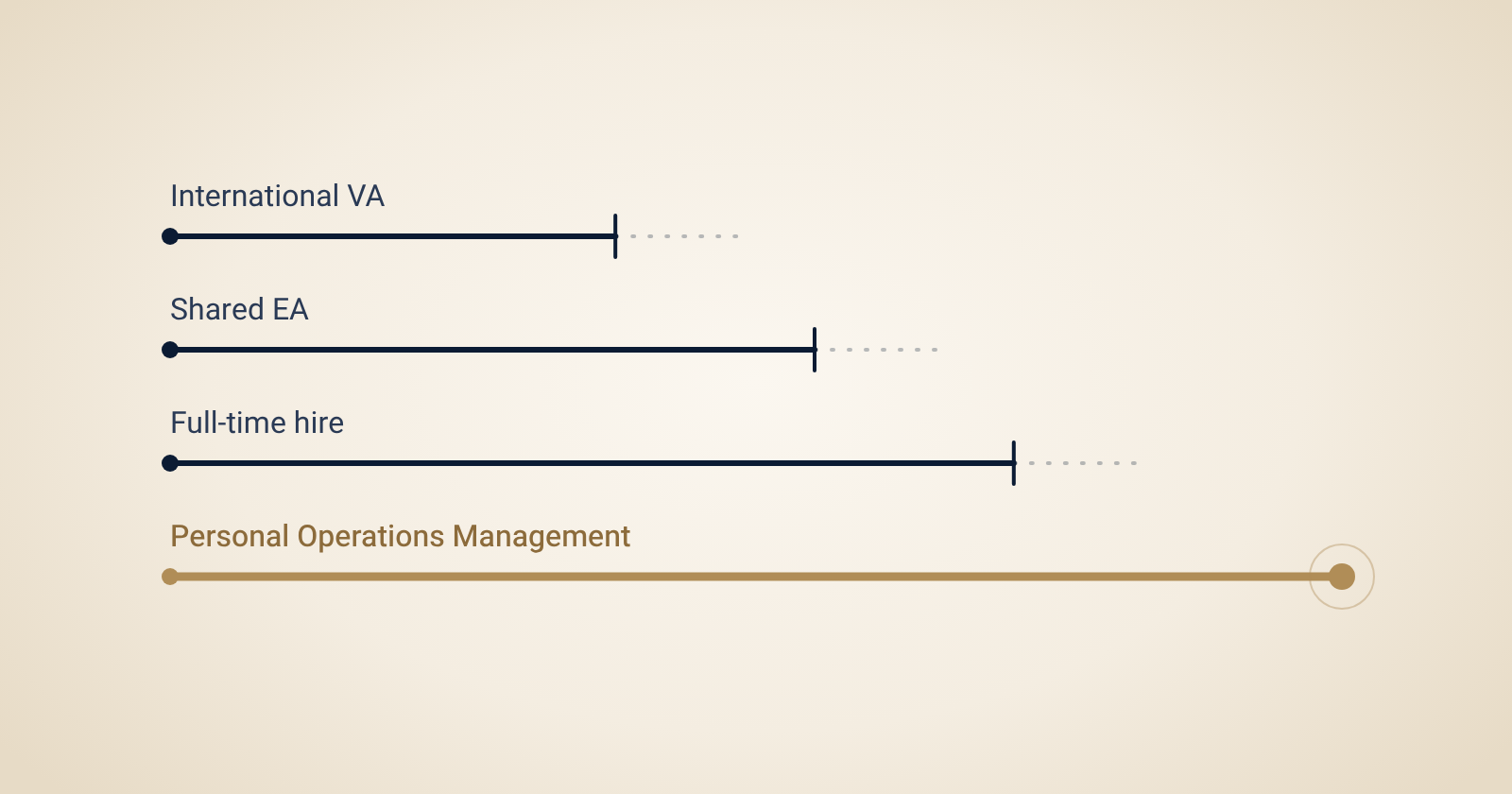
Executives in Israel who want someone to take personal and business operations off their plate usually end up choosing between four options: a full-time hire, an international VA platform, a concierge service, or a shared EA. Each one solves part of the problem. None was built to take full ownership of operations, and that is the gap Personal Operations Management exists to close.
Why do executives reach this point?
You make decisions worth millions, yet a large part of your week disappears into vendor follow-ups, travel logistics, scheduling conflicts and the small tasks nobody else owns end to end.
The problem is not that you are disorganized. It is that no existing system was built to absorb this kind of work at the level of ownership you actually need.
Picture two scenarios. In the first, you remember at 11pm that nobody followed up with the contractor about the delayed delivery. You send a message. Someone picks it up in the morning. Two days later you ask again, because nothing moved. In the second, you never think about it at all. It was resolved before it reached you.
The distance between those two scenarios is the difference between someone who executes tasks and someone who owns the outcome.
What is the difference between execution and ownership?
Execution waits for instruction. Ownership spots open loops and closes them independently. You do not have to remember what you forgot to follow up on, because someone else is already tracking it.
Operations management theory offers a useful frame: operations management is about matching supply with demand. In an executive's life, the supply is attention, and the demand is the stream of decisions, tasks and logistical threads competing for it every day. Personal Operations Management is the system that filters that demand, so attention goes only where it matters.
Another useful operations metric is cycle time: how long it takes from spotting a problem to resolving it. A vendor who does not reply, a home repair that drags on, a follow-up nobody made. For most executives that cycle is measured in days or weeks, because the problem has to surface, be remembered, be handed off and be followed through. Personal Operations Management shortens the cycle by taking the executive out of the middle.
The full definition of the category, and a detailed comparison with other models, is on the page What is Personal Operations Management.
What does it actually need to cover?
When executives hear "personal operations management" they usually think of calendars and some travel. When they start listing what actually eats their week, the picture grows quickly:
- Daily logistics and priorities.
- Protecting the calendar and the inbox.
- Travel planning and coordination.
- Running the home: vendors, repairs, deliveries and maintenance.
- Health and personal appointments.
- Coordinating suppliers and contractors over weeks.
- Proactive follow-up, so nothing falls through the cracks.
Personal and business operations are managed together, by one system accountable for both.
What holds it together is a regular sync with the executive: priorities, decisions and open loops. Without it, small things pile up. With it, nothing is left hanging.
One founder we worked with was spending more than four hours a week coordinating three vendors on a single home renovation. Within two weeks of starting, that entire thread was in our hands and closed, without a single follow-up from him. That is not a productivity hack. It is operational drag removed at the source.
What are the alternatives in Israel, and where does each one stop?
| Model | Good at | Where it stops | | --- | --- | --- | | Full-time hire | High trust and deep context built over years | Fixed salary, employer obligations under Israeli labor law, ongoing management, and dependence on one person who may leave | | International VA platform | Low cost | No continuity, no proactive ownership, no knowledge of Israeli vendors, bureaucracy or logistics | | Concierge service | Restaurant, travel and ticket requests | Reactive by design. Does not hold a thread with a contractor for weeks or keep context across domains | | Shared EA | Day-to-day business work | Usually a high minimum commitment, and does not cover the overlap between personal and business | | Personal Operations Management | End-to-end ownership of both domains, without hiring or managing anyone | Builds context fast, but a full-time hire will still know you more deeply after years |
For most executives, what is missing is not another pair of hands. It is someone accountable.
A full-time hire is a good choice for those who can absorb the cost and management, and it wins on depth of context over time. Most such hires also lean toward one domain, personal or business, and rarely cover both. For executives who need operational ownership without adding headcount, that is usually the deciding factor.
How is Ankora built around the gap?
Ankora combines a dedicated human Operations Manager with AI orchestration. The Operations Manager owns the outcome and decides what needs you. The AI layer remembers preferences and decisions, tracks every open process and flags delays early.
What sets it apart from every alternative is not only scope. The system learns your context, keeps continuity across domains, and handles issues before they reach you. Only what genuinely needs your decision comes to you.
In Israel this matters even more: local vendors, bureaucracy, Hebrew-language coordination, the logistics of travel in and out of the country, and contractors who work on their own timeline. Ankora works inside that context from day one.
Clients have told us the first month was the first time in years they felt caught up on everything open. They also describe the attention they get back as the most important part, more than the hours themselves.
How do you choose the right model?
- Write down one week of operational tasks. Even the small ones. It is the only way to see the real scope.
- Mark how many are personal and how many are business. If there are many of both, a model that covers one domain will leave you in the middle.
- Count how often you followed up on something you had already asked for. Every follow-up is a sign ownership did not move.
- Ask what happens when the person changes. If all the context leaves with them, the model is fragile.
- Count the full cost. Not only salary, but management, replacement and handover time.
If the answers point to a need for ownership rather than more execution, it is worth reading the comparison between Ankora and a personal assistant too.
The goal is not to manage operations better. It is to stop managing them.